Art Blog

The Moment Italy Made Me Look Differently at Art
Before Italy, I thought I knew how to look at art. Throughout my life, I have seen many famous works through studying Art History in school, visiting museums with my mom, or simply studying them on my own. But entering the Galleria Borghese in Rome completely changed my perspective on art. I was already knowledgeable about the sculptures, but I had not really delved into Bernini’s skill. The first thing I learned, and it struck me, was that when Bernini was carving a portrait of Cardinal Borghese, he deliberately inserted a fault line into the sculpture so Borghese would be enraged and send it back to him. Little did Borghese know this was part of Bernini’s plan; he came back with a brand-new sculpture, with no fault lines, in record time. So why did he do all of this? It was to show off his skill. Bernini was a cocky and extremely skillful artist at the time, and I think he did this to show off his wit and once-in-a-lifetime talent.
Bernini’s Rape of Persephone quite literally made my jaw drop. I had seen photographs of it before, but nothing prepared me for seeing it in person. What first caught my attention was Hades gripping Persephone’s thigh. His fingers press into the marble so convincingly that it genuinely looks like real skin. Looking at this sculpture on a screen and experiencing it in person are not the same. Seeing it on the screen, you can understand that Bernini is trying to make it seem realistic, but experiencing it in person, you can actually understand how he did it.
Walking around the sculpture also made the experience even more different. From each angle you look at, you notice something new, which you can not get by looking at a photograph. Persephone’s expression gets clearer, the movement of her body is exaggerated and Baroque-esque, the strands of her hair are wild and going everywhere, and the folds of the fabric are hyper-realistic. I noticed details I had never seen in pictures because I was close enough to really analyze the work, and it made me feel deeply connected to it.
I felt the same thing with Bernini’s David. I had studied this one in depth in my Art History course, so I was most excited to see it. Seeing this one in person made me realize how much scale and position matter. It is almost as if David’s body is twisting through space, and you are in the moment when he is about to kill Goliath. Standing beside him made his movement feel much more sudden and immediate. It interacts with you differently, making you feel like you are in the moment rather than just looking at it.
That experience changed what I think it means to see art. A photo can show me what a sculpture may look like, but it can never show me its scale, the way the light moves across the surface and interacts with the piece, or what it feels like to walk around it. At the Borghese Gallery, I stopped seeing art as something you can understand only on a screen or photo. I started seeing it as something I could physically experience, something I could understand more deeply by being in the same space with it and taking the time to look at it from every angle and decipher it.
Italy did not change the art for me; it changed the way I look at it now.
Aug 24, 2026
How do you actually look at a painting?
Before this summer, I honestly did not enjoy modern art at all. I never really understood it. I would look at a painting full of strange shapes, lines, and colors and wonder what I was actually supposed to be seeing. I usually preferred older art because it felt easier to understand, you could recognize the people, places, and stories.
This definitely changed when I visited Peggy Guggenheim’s collection in Venice and experienced Sea=Dancer by Gino Severini. It’s not like I suddenly became a modern art expert the moment I set eyes on the painting, but it changed the way I look at modern art. Instead of being impatient and immediately asking what the meaning of the painting is, you really have to sit with it for a while until you realize the intricate message the artist is trying to portray.
A good way to start is composition, or in other words, how everything is arranged. Some questions you can ask yourself to help are: Where does my eye go first? Are certain aspects, shapes, or objects more noticeable than others are? In Sea=Dancer a lot is happening at once, and I would be lying if I said I understood the composition quickly. The lines and shapes seem to move around the painting rapidly, so my eyes never really settle in one place.
Then there is color. What colors does the artist use, and how do they affect the feel of the painting? In Severini’s work, the colors and shapes create a sense of energy and movement because he uses an abundance of diverse hues and forms. It isn’t necessarily a realistic depiction of the sea. Its more like an attempt to capture the experience and feeling of being around it. More specifically, the artist’s experience.
Then examine the scale, gesture, light, and perspective. Think about how large things are compared to each other. Do the figures or shapes suggest movement or stagnation? Where does the light source come from, if there is any? How does the artist create space in the painting? Severini depicts the gesture in his painting as active and wild. There is not one thing about his work that is still. He even shows this by having brushstrokes extend beyond the canvas and onto the painting's frame, emphasizing this exaggerated movement. These details together can change the feeling and or message of a painting.
Then there is symbolism and setting. What could these objects, colors, and shapes represent? Where is the scene taking place, and why did the artist choose that setting? You may not always have an answer to these, but sometimes that is the point of the painting. The artist may want you to get lost in your thoughts or contemplate and see where they take you. Not every piece of art has an answer, you are not always trying to figure out the meaning. Do not think of it as a multiple-choice question on a test, think of it as an open-ended question. Obviously, this does not apply to every painting, but it is a mindset you should always keep in the back of your mind when looking at one.
One of the most important things Sea=Dancer taught me was to slow down when looking at art. Before Venice, I would come across modern art that I didn’t understand and quickly dismiss it. I never looked at it long enough to understand what the artist was doing. At the Peggy Guggenheim, I took my time with the painting and began to notice the colors, lines, movement, and, most importantly, how they all came together beautifully. What is confusing to one person can seem intentional to another.
I still don’t understand every piece of modern art, but that's fine with me because I don't have too. I have now started to realize that understanding art isn’t about immediately knowing what the artist meant. Sometimes, it is about looking closely enough to form your own ideas. Sea=Dancer changed my opinion of modern art because it made me realize that I had been judging something before taking the time to try to understand it.
Sep 5, 2026
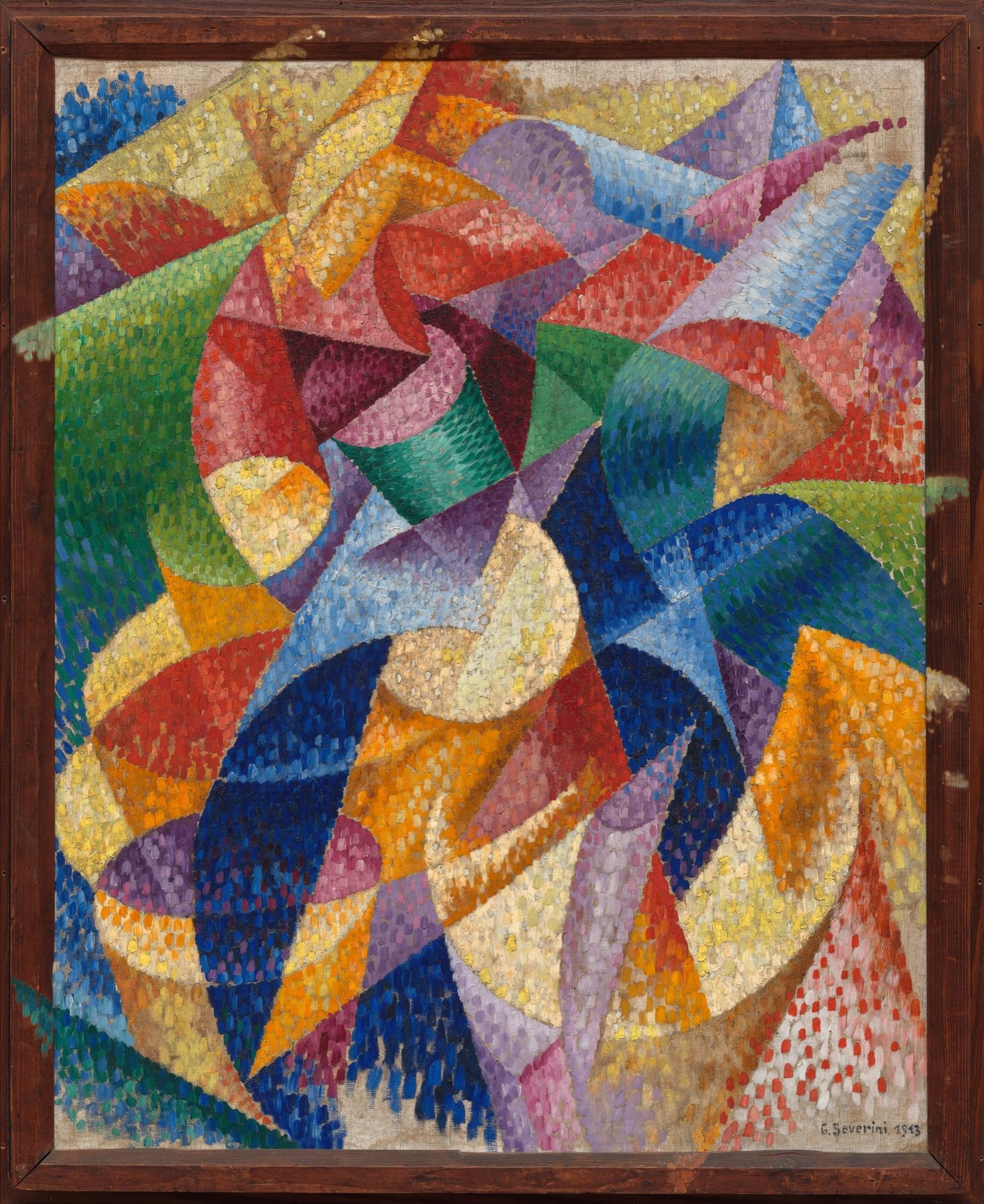
Gino Severini’s Sea=Dancer (Mare= Ballerina) , Oil on canvas, January 1914